
Somebody in Kitchener asked ChatGPT for a good plumber this morning, and it gave them three names. Most Ontario service businesses have no idea whether they’re in that answer — and the ones who assume they are usually aren’t.
This guide breaks down what AI systems actually read before they recommend a local business, the five things worth fixing first, and how to tell whether any of it is working in markets like Waterloo, Kitchener, and Cambridge.
By Jeremy Core | on Aug 20, 2026
Table of Contents
- What Changed: Ten Links Became Three Names
- What AI Actually Reads Before It Names A Business
- 5 Moves That Get You Named In AI Answers
- AI Search vs. Local SEO: The Honest Comparison
- Common AI Search Mistakes We See In Waterloo Region
- How To Tell Whether Any Of This Is Working
- Frequently Asked Questions
- The Bottom Line
- Keep Reading
What Changed: Ten Links Became Three Names
For twenty years, getting found meant one thing: rank on page one, earn the click, take the call.
That deal is changing. A growing share of searches now end in an answer instead of a list — an AI Overview at the top of Google, or a conversation in ChatGPT or Gemini that never touches a results page.
The customer doesn’t get ten links to weigh. They get three names. Sometimes one.
Here’s the part worth sitting with: AI search doesn’t rank you, it either says your name or it doesn’t. There’s no page two to console yourself with.
Now the honest concession, and it’s a real one. The people shouting that “SEO is dead” are selling something.
Traditional search still drives the overwhelming majority of local calls in this region. A furnace failing at 11pm in February is still a Google Maps search, not a chat session.
The same is true of paid — if you’re weighing budget between channels, that’s a separate question we worked through in our guide on PPC vs. SEO for Ontario service businesses.
But the direction of travel isn’t ambiguous. The businesses that get named a year from now are the ones doing this work quietly today, while their competitors argue about whether it matters.
What AI Actually Reads Before It Names A Business
Here’s what surprises most owners: an AI recommending a local plumber isn’t doing anything mystical.
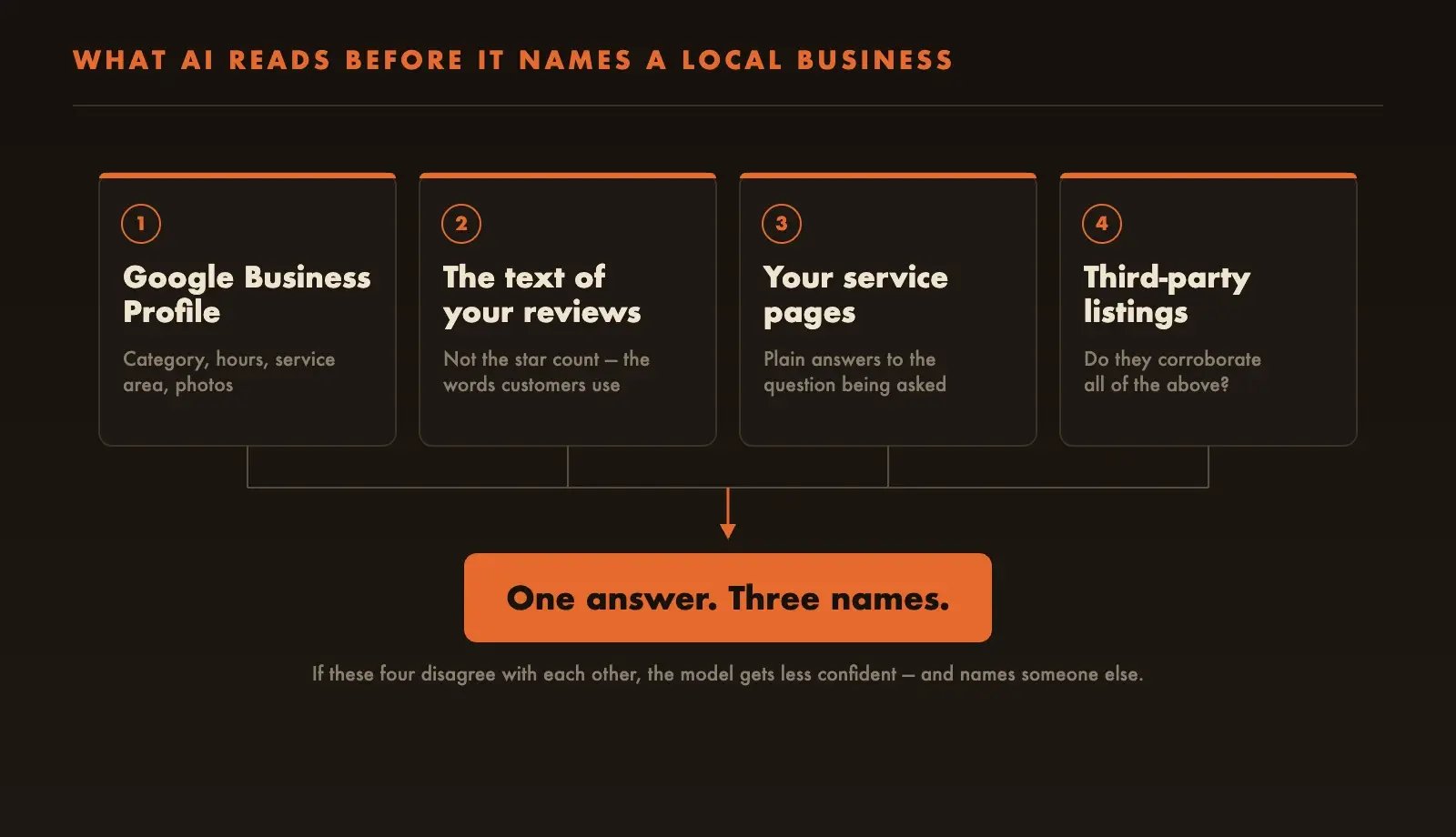
It’s reading a small, boring set of sources and looking for agreement between them. When those sources agree, it gets confident enough to say your name. When they conflict, it picks somebody safer.
The four sources doing the work
- Your Google Business Profile: the densest packet of verified facts about your business anywhere online — category, service area, hours, photos, Q&A, and every review attached to it.
- Your reviews, read as text: not just the star count. These systems read the actual words and pull out themes — showed up on time, quoted honestly, fixed it in one visit.
- Your service and location pages: where you state plainly what you do and where you do it, in language a machine can parse without guessing.
- Third-party listings and mentions: directories, the chamber of commerce, local news, supplier dealer-locator pages. This is the corroboration layer — the machine checking your story against everyone else’s.
Google’s own documentation is unusually blunt about this. Its guidance on AI features and your website states plainly that there are no additional requirements to appear in AI Overviews, and no special optimizations necessary.
The same page puts “check that your Business Profile information is up to date” directly on the best-practices list.
There is no separate AI ranking dial. There’s just being less ambiguous, in more places, than the shop down the road.
Why consistency matters more here than it used to
A person who finds two different phone numbers for you will shrug and try one.
A language model does something different. It downgrades its confidence in the whole business and reaches for one it’s more certain about.
One stale phone number on a directory you forgot existed is genuinely enough to cost you the mention. That isn’t a scare tactic — it’s how confidence scoring works when a system has to commit to three names.
Which is why ranking in the Maps Pack and getting named by AI turn out to be the same project.
5 Moves That Get You Named In AI Answers
1. Fix your primary category and keep the profile alive
Your Google Business Profile’s primary category does more for local visibility than any other single setting, and it’s the thing we most often find set wrong.
A drain specialist filed under “Plumber.” A furnace company filed under “HVAC contractor” when “Heating contractor” is what people around here actually search.
Then keep it moving. Photos, posts, answered questions. A profile that’s been static since 2023 reads as a business that might not exist anymore.
Category selection, posting cadence, and the review engine behind it are the core of Local SEO Surge, and it’s where we start with nearly every client.
2. Make your reviews say something quotable
Star ratings are a ranking input. Review text is a summarization input — it’s the raw material a model uses to explain why it recommended you.
A wall of “Great service, thanks!” gives it nothing to work with.
A review that says “came out same day for a burst pipe in Elmira and charged exactly what he quoted” gives it a sentence it can practically reuse.
You get those by asking better. Not “leave us a review,” but “if you have a second, it helps a lot if you mention what we came out for and how it went.”
3. Answer the real question on the actual page
Most service pages read like brochures. A paragraph about quality and commitment, then a phone number.
No machine can extract a recommendation from that.
Write the page so the answer to the customer’s real question sits in plain text — what it costs, how long it takes, what area you cover, what happens on the first visit.
That’s the whole point of building out service and location pages properly. A page that answers plainly ranks well and quotes well.
4. Make your structured data match what people read
Fair warning first: Google explicitly says there’s no special schema you need to add for AI features, and no “AI text file” to create. Anyone selling you one is selling you a file.
What Google does ask, on that same page, is that your structured data match the visible text on the page.
That’s the real job — LocalBusiness, Service and FAQPage markup that agrees with what a human reads, all pointing at the same name, address and phone number.
It’s invisible to customers and unglamorous to implement, which is exactly why most local sites either skip it or let it drift out of sync. Handled properly it’s part of a mobile-first, conversion-focused build, not a plugin you switch on and forget.
5. Get mentioned where the machines already look
Corroboration is the whole game.
A local news mention, a supplier’s dealer locator, a chamber page, a trade association directory — each one is another independent source telling the same story about you.
This is old-fashioned authoritative backlink work, and it turns out to be one of the highest-leverage things you can do for AI visibility.
The machine isn’t impressed by your website calling you the best. It’s persuaded by four other places agreeing you exist and do what you claim.
AI Search vs. Local SEO: The Honest Comparison
If that list felt familiar, good. It should.
The uncomfortable truth for anyone selling “AI optimization” as a separate product is that there’s very little separate about it.
| What you fix | Effect on local search | Effect on AI answers |
|---|---|---|
| GBP category and activity | Maps Pack ranking | Primary source for local recommendations |
| Review volume and text | Ranking and click-through | Supplies the “why we recommend them” line |
| Consistent details everywhere | Trust and ranking signal | Confidence threshold for naming you at all |
| Clear service and location pages | Organic rankings | Extractable, quotable answers |
| Structured data | Rich results | Unambiguous machine-readable facts |
| Local mentions and links | Authority | Corroboration across sources |
Every row pays twice. That’s the argument for doing this now rather than waiting to see how AI search settles — none of it is a bet on one platform surviving.
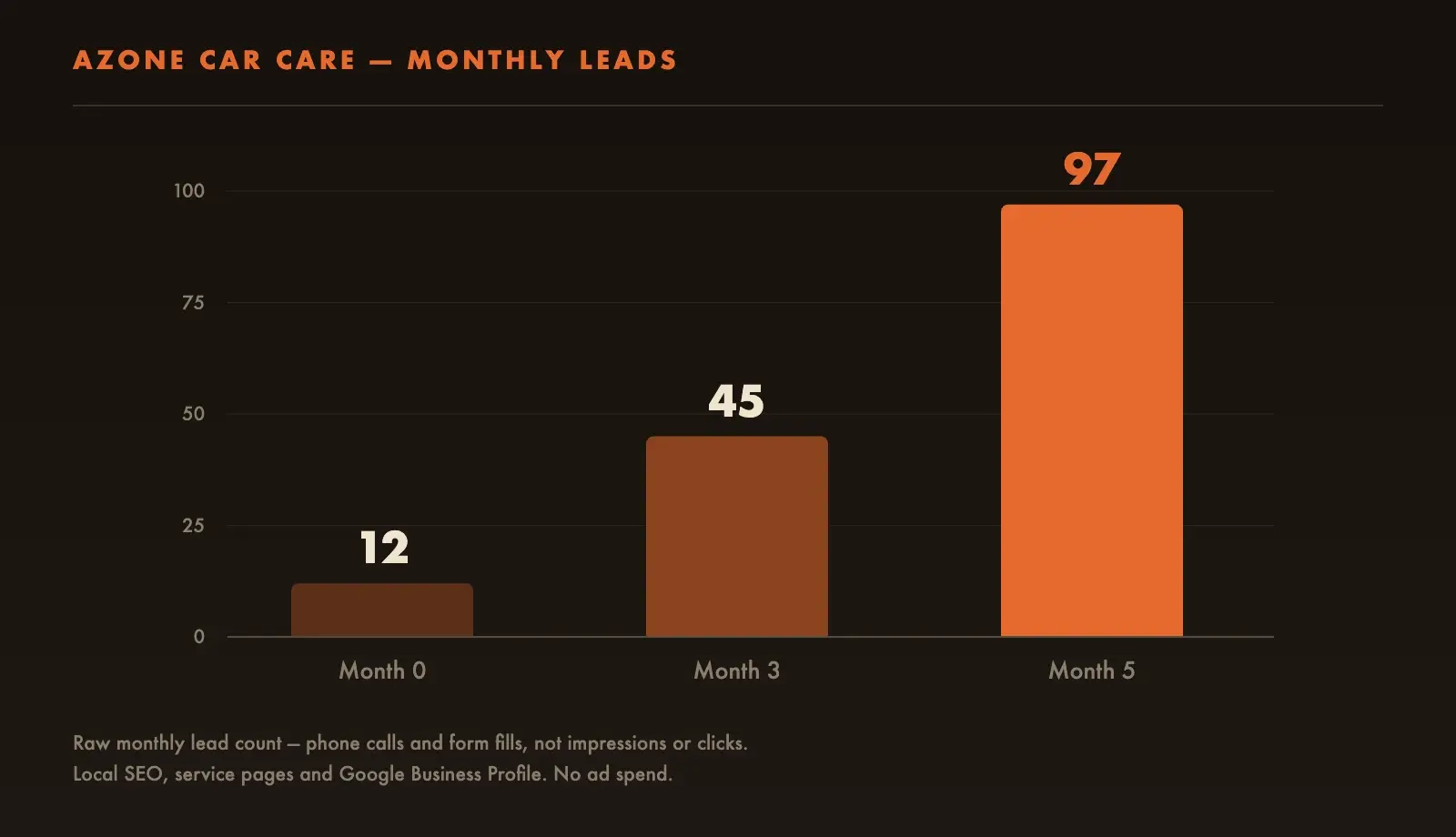
When we rebuilt Azone Car Care from scratch, after their previous agency compromised their site and held it for ransom, none of the work was “AI optimization.”
It was categories, reviews, pages and consistency. Monthly leads went from 12 to 45 in under 90 days, and reached 97 by month five.
The leads weren’t the only thing that moved. Inbound calls went from 11 a month to 54, form submissions from 1 to 43, and site sessions from 34 to 429.
That same foundation is what makes a business quotable.
Common AI Search Mistakes We See In Waterloo Region
Chasing the tool instead of the fundamentals
Every few weeks a new product promises to “optimize you for ChatGPT” for a monthly fee.
Most are a dashboard wrapped around work you either did or didn’t do on your Google Business Profile. If your category is wrong and your last review is from 2024, no tool talks a model into recommending you.
Letting old directory listings rot
The listing you made in 2019 with the old suite number is still out there, still being read, still quietly undermining you.
Nobody audits these because nobody visits them, which is precisely why they cause damage. Cleaning up citations across the directories that feed the big platforms is unglamorous, and it’s a standing part of our local search work.
Writing for the machine instead of the customer
We’ve started seeing local sites stuffed with robotic FAQ blocks written to bait AI citations.
It reads like a machine talking to a machine, and it converts terribly when an actual homeowner lands on it. Write it for the person. The clarity that helps them is the same clarity a model needs.
Assuming proximity still saves you
In the Maps Pack, being close has always carried enormous weight — closest relevant business wins.
Early evidence suggests distance behaves differently inside AI-generated local results. Treat that as a signal rather than settled science, because the field is young and the data is thin.
The practical read: being nearby may not carry you the way it used to, and prominence and clarity carry more of the load.
Treating it as a project instead of a habit
A profile optimized once and abandoned decays.
This is maintenance — weekly posts, ongoing review asks, listings checked quarterly. Unglamorous, and it compounds.
How To Tell Whether Any Of This Is Working
Here’s where I’ll be straight with you: AI search measurement is not mature. Anyone handing you a clean “AI ranking report” is showing you an estimate dressed as a fact.
What you can do honestly:
- Ask the machines yourself, on a schedule: run the same handful of prompts — “best [your trade] in Kitchener” — monthly across ChatGPT, Gemini and Google AI Overviews, and log what comes back. Crude, but it’s real observation.
- Watch referral traffic from AI sources: these now show up in analytics referral reports. The volume is small; the trend is the signal.
- Watch Search Console: Google confirms that pages appearing in AI features are included in your Search Console performance data, so your existing reporting already covers some of this.
- Watch profile interactions, not just rankings: calls, direction requests and website clicks are what actually pay. East End Annie’s hit double their projected monthly leads by month two, with profile interactions climbing to 362 a month.
Judge this the way you’d judge any marketing: by whether the phone rings more. Everything else is a proxy.
If you’d rather not guess at where you stand, that’s what a free discovery call is for.
Frequently Asked Questions
Do I need to do anything special to appear in Google’s AI Overviews?
No separate submission or setting exists. Google’s guidance is that the same crawlable, useful, clearly written content that earns normal rankings is what feeds AI features. A complete, active Google Business Profile does most of the heavy lifting for local queries.
How does ChatGPT decide which local businesses to recommend?
It draws on web content plus live search results, and leans hard on sources where your business details are consistent and corroborated. Conflicting information across directories is one of the most common reasons a business gets skipped.
Is AI search going to kill my website traffic?
Some informational traffic is already eroding — the “what temperature should my water heater be” type of visit. Transactional local searches behave differently, because someone with a flooded basement still needs a name and a number they trust.
Your site’s job shifts toward converting rather than explaining, which puts more weight on how fast and how clearly the site actually converts.
How long does it take to see a difference?
Google Business Profile corrections can move things in 30 to 60 days. Listing cleanup and review accumulation take a quarter or more to fully propagate, because you’re waiting on other platforms to update and get re-crawled.
Should I pay for an AI visibility tracking tool?
Not before the fundamentals are handled. If your category is wrong, your details conflict across five directories and you have eleven reviews, a tracking tool will document that in a nicer font. Fix the inputs first.
Does this work for a one-truck operation?
It works especially well. The moves that matter most — correct category, real reviews, consistent details, plain-language pages — cost effort rather than budget.
This is one of the few areas where a small local operator can out-execute a national competitor, which is why we work exclusively with local service businesses in this region.
The Bottom Line
- AI search doesn’t rank, it names. You’re in the answer or you’re invisible — there’s no page two.
- Your Google Business Profile is the spine. Correct primary category, active posting and real photos do more than anything else on this list.
- Consistency is the confidence threshold. Conflicting details are enough to get you skipped for a safer answer.
- Review text matters as much as the star count. Specific reviews give a model something quotable about you.
- Nearly all of it doubles as local SEO. Every fix pays in both places, which is why none of it is a gamble.
The businesses named by AI in 2027 won’t be the ones who found a clever trick. They’ll be the ones whose facts have agreed with each other, everywhere, for two years straight.
Keep Reading
- Local SEO For Ontario Service Businesses — the keyword, on-page and Maps Pack fundamentals.
- Local Lead Generation For Service Businesses — the full system for turning local search into booked jobs.
- How to Rank #1 on Google Without Blowing Your Budget — what actually moves rankings when the budget is tight.
Ready To Own Your Local Market?
Your competitors are still arguing about whether AI search matters instead of fixing the categories and listings that decide it.
That’s the Dogwood Search Engineering System — guaranteed to deliver 20–30 qualified leads per month. Not traffic. Not impressions. Booked jobs.
Want to know what an AI search actually says about your business right now? Book a free discovery call and get a growth roadmap for your business — before you spend a dollar.
Leave a Reply